

With more than two decades of experience spanning financial markets, digital banking, retail, and energy, the Brazilian cybersecurity executive has built a career protecting critical operations and leading complex security transformations. Today, as CISO at Aegis Tech LLC, he brings that expertise to organizations across the Americas.
When a cyberattack strikes, the consequences can extend far beyond compromised systems. Financial transactions may be disrupted, sensitive information exposed, and years of institutional trust placed at risk. In those critical moments, an organization’s ability to respond depends not only on technology but also on the expertise, leadership, and strategic decisions established long before an incident occurs.
For more than two decades, Brazilian cybersecurity executive Pablo de Araújo Brêtas has built his career around that responsibility. From investigating sophisticated threats against financial institutions to developing security programs for digital banks, major retailers, and energy companies, his professional journey reflects the evolution of cybersecurity from a technical discipline into an essential component of corporate governance.
Today, Brêtas serves as Cyber Security Consultant and Chief Information Security Officer (CISO) at Aegis Tech LLC, a Florida-based company providing executive-level cybersecurity expertise to organizations across North and South America. His position represents the culmination of a career shaped by hands-on technical experience, increasingly complex leadership responsibilities, and an understanding of how security decisions influence business resilience.
Building Expertise from the Ground Up
Brêtas began his professional journey in 2005 as an IT support technician at a traditional food manufacturer in Rio de Janeiro. Having completed technical studies in Industrial Informatics, he entered the workforce managing networks, supporting Windows and Linux environments, and working directly with firewalls, proxy servers, and corporate infrastructure.
Those early responsibilities provided a practical understanding of the systems that businesses depend upon. Rather than approaching cybersecurity exclusively through theoretical frameworks, Brêtas developed his expertise by confronting operational challenges and understanding how technical vulnerabilities could affect daily business activities.
His advancement came quickly. In 2007, he was promoted to Information Security Analyst, assuming responsibilities involving security policies, vulnerability management, and risk planning. He subsequently completed a degree in Information Technology Management at Centro Universitário Newton Paiva in 2010, complementing his technical background with formal management education.
His next professional experiences expanded his exposure to complex corporate environments. At a multinational information technology corporation, he worked as an outsourcing security consultant serving multiple enterprise clients. He later joined Brazil’s main securities, commodities, and futures exchange, one of the largest market infrastructure companies in the world, where he investigated security incidents and conducted penetration testing of web applications and infrastructure.
Working in the financial market introduced Brêtas to environments where security failures could have consequences extending across institutions, investors, and interconnected financial systems. The experience also strengthened his understanding of regulatory expectations, risk management, and the importance of maintaining operational continuity.
Throughout this period, he pursued professional certifications involving COBIT, ISO/IEC 27002, and ITIL, developing a foundation that combined technical security practices with governance and service management.
Protecting Financial Institutions and Building Security Operations
A significant chapter in Brêtas’s career began in 2013, when he joined a leading Brazilian financial services group and one of Latin America’s largest investment platforms.
As a senior information security analyst, he investigated advanced persistent threats, spear-phishing campaigns, and attempted fraud involving customer-facing investment systems. His responsibilities included protecting environments where the confidentiality, integrity, and availability of information were essential to maintaining investor confidence.
Following a period at one of Brazil’s largest pay-TV programming companies, where he developed security performance indicators adopted across the organization, Brêtas returned to the investment group in 2017 with an expanded professional perspective.
His transition into leadership accelerated in 2018, when he became Information Security Coordinator. In this role, he contributed to the development of the company’s Security Operations Center, implemented security monitoring capabilities using Splunk SIEM, and supported defenses against advanced cyber threats.
In 2019, he also defined the Microsoft Azure cloud security architecture for the group’s cryptocurrency exchange initiative, demonstrating his ability to adapt security practices to emerging financial technologies.
These experiences helped establish an important characteristic of his professional approach: cybersecurity could no longer be treated simply as an isolated technical function. It needed to evolve alongside business strategy, digital transformation, and the risks associated with increasingly interconnected services.
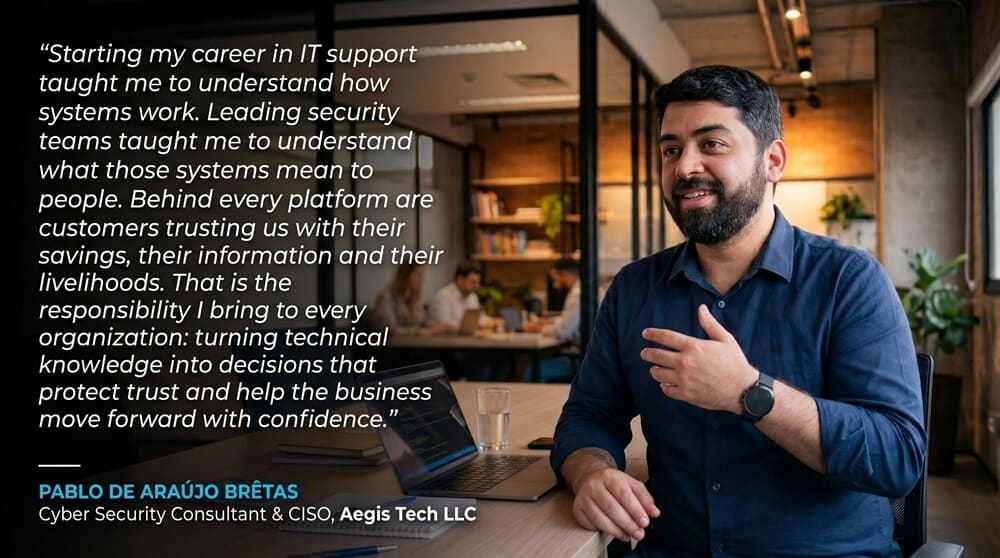
“The most effective cybersecurity strategies are not built around technology alone. They emerge when technical expertise, business objectives, and risk management work together to protect what matters most to an organization.”
Leading Security Transformation Across Industries
As Brêtas progressed into senior management, his responsibilities expanded beyond investigating threats to building security capabilities, leading multidisciplinary teams, and managing significant corporate investments.
In 2019, he joined a multinational technology services provider headquartered in Brazil as Information Security Manager, overseeing a team of 22 professionals and an annual budget of approximately R$25 million. His responsibilities included developing a Security Operations Center designed to support both the company’s internal operations and its corporate clients.
The position required coordinating technical resources, operational priorities, and business expectations within an international technology services environment.
Later that year, Brêtas moved into digital banking when he joined one of Brazil’s fastest-growing digital banks and fintech companies. Between 2019 and 2021, he played a central role in establishing the organization’s Blue Team, Red Team, Application Security, and Security Engineering functions.
Building these capabilities required more than recruiting technical specialists. It involved defining responsibilities, implementing security processes, and creating an operational structure capable of supporting a financial institution serving millions of customers.
His performance led to an invitation to become a partner in 2020, reflecting the company’s recognition of his contributions to its security operations.
In 2021, Brêtas also participated in a working group associated with Brazil’s Open Finance initiative, contributing to discussions on security standards and practices for an increasingly interconnected financial ecosystem.
His subsequent leadership at a digital investment platform belonging to Latin America’s largest investment bankfurther demonstrated the financial impact of effective cybersecurity governance. At the investment platform, which managed approximately R$14 billion in assets, he directed cloud governance initiatives that addressed 90% of identified security risks while reducing annual operating costs by approximately R$1 million.
The organization also successfully completed its BSM regulatory audit during his tenure, reinforcing the connection between security management, operational discipline, and regulatory compliance.
Brêtas later brought his expertise to one of Brazil’s oldest and most traditional retail chains, where he managed an information security budget of approximately R$10 million and structured cybersecurity defense and governance teams. The role introduced additional challenges associated with protecting extensive retail operations and financial services.
From 2023 to 2025, he served at a Brazilian energy trading and renewable generation company, where he established the company’s Information Security function and worked to integrate corporate cybersecurity with Operational Technology (OT) security.
Unlike conventional IT environments, operational technology supports physical processes and infrastructure, making security decisions especially important for business continuity and operational reliability. His responsibilities included addressing regulatory requirements associated with institutions such as ANEEL, CVM, and ONS.
Across these organizations, Brêtas developed a professional perspective shaped by diverse industries but connected by a common challenge: protecting complex businesses while enabling them to innovate, expand, and operate with confidence.
Beyond Corporate Leadership: Contributing to the Cybersecurity Debate
Brêtas’s professional activities extend beyond executive management. Through articles published in international technology and business publications, he has contributed perspectives on cybersecurity challenges, cloud governance, and organizational leadership.
In “The Essential Role of Micro-segmentation in Protection Against Advanced Persistent Threats,” published by Tech Feast, he examined the limitations of traditional perimeter-based security models and explored how network micro-segmentation can restrict the movement of attackers within compromised environments.
The subject reflects his practical experience investigating advanced persistent threats and his specialized training in segmentation technologies, including the Guardicore Certified Segmentation credential.
His article “Cloud Computing Security: Challenges and Essential Strategies,” published by The BOSS Magazine, addressed vulnerabilities associated with cloud environments, including configuration errors, inadequate identity and access management, and insufficient encryption controls.
The publication also explored the importance of regulatory compliance, including Brazil’s General Data Protection Law (LGPD), connecting technical safeguards with organizational accountability.
In another publication, “Project Management Structures: Foundations for Success in a Constantly Changing World,” featured in TechPout, Brêtas expanded the discussion beyond cybersecurity to examine how organizations can structure projects using methodologies such as Agile, Lean, PRINCE2, and Six Sigma.
Although these publications address different subjects, they share a consistent perspective: successful technological transformation depends on effective governance, adaptable management practices, and the ability to align specialized expertise with broader organizational objectives.
His involvement in professional development has also included sharing career insights with students. In 2021, he spoke at Universidade de Rio Verde (UniRV) about professional opportunities and employability in software engineering, contributing his experience to discussions about career development in technology.
Together, these activities illustrate a professional whose expertise is not confined to operational execution but also encompasses the communication of technical knowledge and leadership principles to wider audiences.
Bringing Brazilian Cybersecurity Expertise to the Americas
In August 2025, Brêtas began a new chapter as Cyber Security Consultant and CISO at Aegis Tech LLC, headquartered in Florida.
The company provides executive-level information security leadership to businesses across North and South America, offering organizations access to strategic cybersecurity expertise without necessarily maintaining a full-time internal CISO position.
For Brêtas, the role represents an opportunity to apply the lessons developed throughout his career to organizations operating in different industries, regulatory environments, and stages of technological maturity.
His responsibilities include developing information security strategies aligned with internationally recognized frameworks such as ISO/IEC 27001, NIST Cybersecurity Framework, and COBIT.
He also leads incident response activities, develops security architectures, oversees penetration testing involving web applications, APIs, and mobile systems, and advises clients on third-party risk management and employee security awareness.
Beyond technical and advisory responsibilities, Brêtas contributed to developing the firm’s service portfolio and market-entry strategy, including its multilingual digital presence in English, Portuguese, and Spanish.
This combination of technical leadership and business development reflects the increasingly strategic nature of the CISO position.
Modern security executives must understand how cyber threats affect financial performance, regulatory exposure, customer confidence, and long-term organizational sustainability. Their responsibilities extend beyond preventing attacks to helping executives make informed decisions about technology investments and enterprise risk.
Having worked across financial markets, digital banking, retail, and energy, Brêtas brings experience from environments with different operational demands but similarly high expectations for security and resilience.
A Career Defined by Leadership, Governance, and Resilience
The trajectory of Pablo de Araújo Brêtas reflects a broader transformation within the cybersecurity profession.
What began as a field frequently associated with technical infrastructure and incident prevention has evolved into an executive discipline closely connected to corporate strategy, governance, and institutional trust.
Throughout his career, Brêtas has worked at different levels of that transformation. He has investigated attacks, designed security architectures, developed operational teams, managed multimillion-real budgets, and contributed to security governance across industries where technological failures can produce significant business consequences.
His experience also demonstrates the importance of building organizations capable of anticipating and responding to threats rather than relying exclusively on reactive defenses.
From a technical support desk in Rio de Janeiro to executive security leadership serving companies across the Americas, Brêtas has built his professional reputation through progressively complex responsibilities and measurable contributions to organizational security.
As cyber threats become more sophisticated and regulatory expectations continue to evolve, his career offers an example of how technical knowledge, strategic judgment, and leadership experience can converge to support digital resilience.
By Nova Sinclair