
People are looking for Elasticsearch alternatives because it has a lot of features that are present in other tools. It has a memory-intensive architecture, which leads to very high operational expenses. And managing the clusters demands expertise and specialization, and it does not have any beginner-friendly interface. Because of all these kinds of factors, one must look for an alternative that has advanced features and is better than Elasticsearch.
In this article, you will know about the factors you must look at in the Elasticsearch alternatives, which is also a better Data Visualization Software, and a list of some of the better Elasticsearch alternatives.
Critical Factors to Look for in Elasticsearch Alternatives
There are some factors that lack Elastic search and that we need in our Elasticsearch alternative. So here are some of those factors one must check before selecting an Elastic search alternative.
Infrastructure Cost
To select an Elastic search alternative, one must look for the options that have a transparent pricing model and no hidden fees included. Because the cost really matters, we perform budget predictability and scale the economics.
Complexity in Operations
The best Elastic search alternative must have an operational simplicity that helps in reducing management overhead. Check for cluster set complexity and all its auto-scaling capabilities before selecting an Elasticsearch alternative.
Storage
For selecting an Elastic search alternative, one must check for the storage efficiency and long-term data retention costs. You should make sure of the compression ratios and storage formats as well. And before selecting, also make sure about the cold storage options.
Completeness of Features
Always try to avoid tool sprawl and make sure to get all the logs, metrics, and traces in one platform. Check for the alerting capabilities of that alternative. It should also have dashboards/visualization tools and Real User Monitoring (RMU).
Scalability
Before selecting an alternative, check for growth accommodation and a horizontal scaling model. Check if it has a stateful vs. stateless architecture or not. It should support multi-tenancy and disaster recovery (RPO/RTO).
Best Elasticsearch Alternatives
Here is the list of some of the best Elasticsearch alternatives you can use in 2026 which have more advanced features than Elasticsearch and are better and more scalable Database Management Software than it is.
1. Meilisearch
One of the most flexible and powerful Elasticsearch alternatives is also a very user-focused search engine. It searches as you start typing and return with answers in less than 50 milliseconds. Out of all the Elasticsearch competitors, this is the one that supports reliable and performant search.
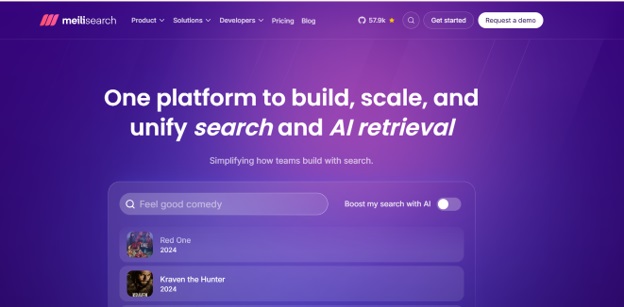
Key Feature: Here are all the key features of Meilisearch:
- It has typo tolerance that directly corrects the misspellings.
- There are features of hybrid search and semantic search to combine keywords and enhance accuracy.
- There is also built-in faceted filtering.
- Easy to set up and SDK support multiple languages.
Pros:
- Easy to deploy
- Typo tolerant
- Developer-friendly
- Customizable ranking rules
- Supports complex filtering
Cons:
- Smaller ecosystem
- Limited Scale
- Limited support for multi-tenancy
- Not suitable for log analytics
Also know: Best Kids Search Engines That Are Safe to Use
2. Algolia
Algolia is a hosted search-as-a-service and Data Labeling Software Elasticsearch alternatives platform that was designed for creating exceptional search experiences for their users. It influences machine learning algorithms, which help in optimizing relevance and support rich features. It is quite beginner-friendly with advanced features like advanced typo tolerance, personalized search experiences, and merchandising tools.

Key Feature: The following are all the important key features of Algolia:
- It helps search analytics to identify the top-performing content and helps in optimizing results as well.
- For all the precise queries, it has extensive typo tolerance and synonym management.
- It supports APIs for several languages (.NET, Python, PHP)
- It helps in integration with multiple major CMS and e-commerce platforms.
- It is a very straightforward user-friendly tool to use in 2026.
- It provides excellent documentation and onboarding.
Pros:
- Instant Search
- AI-Powered Relevance
- Faceted Search
- Easy Integration
- Global Infrastructure
Cons:
- Premium pricing compared to self-hosted alternatives.
- SaaS only, no self-hosted options for any kind of on-premises requirements of a user.
- Not designed for log management
- Provides less control than self-hosted solutions.
3. Typesense
Typesense is an open-source search engine that focuses on simplicity, speed, and cost-effective features. Out of all the Elasticsearch competitors, this is the one that offers real-time, as-you-type search with relevance ranking powered by AI. And it also supports a faceted, semantic, recommendation-based search.
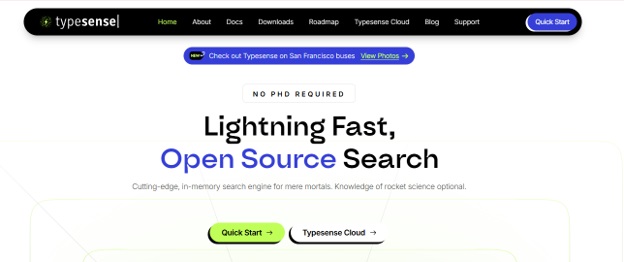
Key Feature: The following are all the important key features of Typesense:
- It has an instant search with an auto-completion feature.
- It also provides personalized recommendations according to user behavior.
- It also offers free self-hosted options and has affordable managed hosting plans.
- Supports multi-language API clients that include JavaScript, Python, and Ruby.
Pros:
- It has a very simple setup and fast performance
- Intelligent Typo Tolerance
- Intuitive API design
- Rich in filtering and faceting capabilities
- Buit-in support for location-based queries
Cons:
- Not designed for log management
- Not suitable for petabytes
- No distributed mode
- No complex analytic
4. Manticore Search
One of the most effective and developer-friendly Elasticsearch alternatives, designed for speed and extensive search capabilities. It supports SQL-like queries to help developers with familiar databases and to interact with the search engine. It has efficient compression and analytical performance. This also supports embedded-based semantic search and horizontal scaling.
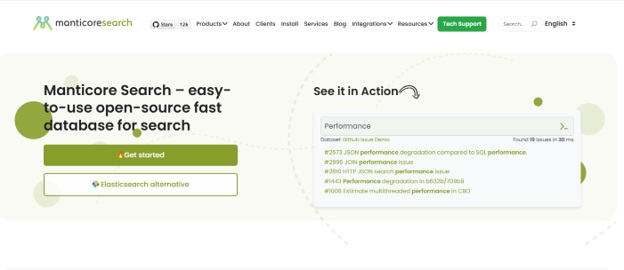
Key Feature: The following are all the important key features of Manticore search:
- It has faster search performance.
- It supports real-time indexing and query processing.
- There are over 20 full-text operators and ranking factors that help in complex queries.
- It has a multi-data format and is also SQL compatible with query language.
- It is open source and free for everyone to use and has strong community backing.
Pros:
- High Performance
- SQL Interface
- Efficient analytical query performance
- Establishes supports for embedding-based semantic search
- Support for horizontal scaling
Cons:
- Small Ecosystem
- Smaller user base for community support
- There are some advanced features missing.
- There are no built-in dashboards.
Best Reverse Image Search For Free
5. Apache Solr
Out of all the Elasticsearch competitors, this is the one that offers powerful distribution of search engines with scalability. One of the best Elasticsearch alternatives is that it is suitable for large-scale enterprise applications. It has a lot of user-friendly features, is rich in documentation, and has a very powerful supportive community. Its strength lies in its ability to handle complex and full-text search queries.
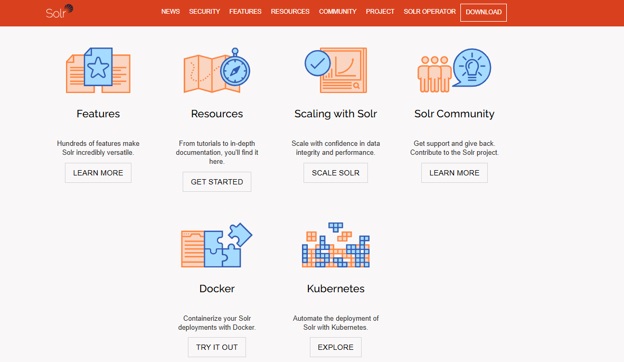
Key Feature: The following are all the important key features of Apache Solr:
- It has a standard-based open interface that uses JSON, XML, and HTTP to support easy integration.
- It has built-in UI for administration and query examinations.
- This tool is scalable and distributes data architecture for heavy workloads.
- This has an extensible plugin that supports MySQL, Drupal, and Magneto.
Pros:
- True open source
- Rich in Query Language
- Supports REST API, XML/JSON/CSV formats
- Best for content management
- Has very flexible deployment
Cons:
- Less focus on log analytics
- Smaller ecosystem
- Not suitable for unified observability
- UI is outdated when compared to modern tools
Frequently Asked Questions (FAQs)
Q1. What are the best tools for a small-to-medium application search?
Ans. The best tools for small-to-medium application search are:
- Typesense
- Milei search
Q2. Why should one select an Elastic search alternative?
Ans. The following are the reason why teams are seeking for Elastic search alternative:
- Higher cost optimization scale
- Operational Complexity
- Scale of Performance
- Data Sovereignty
Q3. Are there any other alternatives one should consider?
Ans. Yes, there are other alternatives as well, such as Open Observe, OpenSearch, Click House, Splunk, and many more.
So, this was all about the selection of Elasticsearch alternatives along with the factors one should consider and a list of the best alternatives to use in 2026. The choice of the right alternative depends on the use case, team expertise, and scalability requirements of the user.